

The Cleveland Guardians enter the final three weeks of the 2026 season barely in possession of the American League’s last wild-card spot. At 73–72, they lead Toronto by half a game, trail the first-place Chicago White Sox by three, and have little room for another sleepy week. That is the good news and the warning in the same sentence. Cleveland controls its path to October, but control means nothing if the club keeps playing like a team waiting for somebody else to seize the moment.
The Guardians do not need a miracle. They need urgency, sharper choices and a lineup that stops asking a pitching staff to win every game with three runs. If Cleveland wants to be more than a temporary occupant of the sixth seed, major things must happen now.
Vogt must simplify the lineup and trust the hot hand
Stephen Vogt deserves credit for handling the pitching staff, but his lineup construction and position-player substitutions have drawn fair scrutiny. Cleveland needs to stop tinkering and settle on its best lineup for the stretch run. Vogt rarely uses the same order on consecutive days. It’s head shaking at times how aggressively he has mixed and matched throughout the season. Injuries and front-office input complicate those choices, but September is no longer the time for constant experimentation. Vogt should identify the healthiest, most productive core, keep it together whenever matchups allow, and resist removing a hitter who is seeing the ball well simply because a pregame platoon plan says otherwise. The Guardians need adaptability, not over management and in close games, every pinch-hit, bunt, defensive switch and stolen-base attempt must have a clear purpose.
Stop treating four runs like a luxury

Photo by Charles Murray
Cleveland ranks 28th in the majors at roughly four runs per game, 29th in home runs and 25th in batting average. That is not merely an aesthetic problem it is the central threat to the season. The rotation has done enough. The bullpen has done enough. The offense must stop making every sixth inning feel like sudden death.
Vogt should build the batting order around current production rather than reputation but he also needs a contingency plan while Chase DeLauter is unavailable. DeLauter, Cleveland’s most consistent hitter, is day to day with a right wrist sprain and has missed three straight starts. Although he is trending in a positive direction and the club does not currently view it as an injured-list situation. When healthy, his .294 average and .458 slugging percentage belong near the center of the attack. Until then, Steven Kwan’s .372 on-base percentage and the speed supplied by José Ramírez, Travis Bazzana and Brayan Rocchio must drive a more aggressive, pressure-based lineup. Put the best available on-base bats together, force pitchers into the stretch and turn singles and walks into runs. This team is unlikely to become a home-run machine overnight, so it must manufacture crooked numbers instead of hoping for them.
Shorten the rotation and every manager’s leash
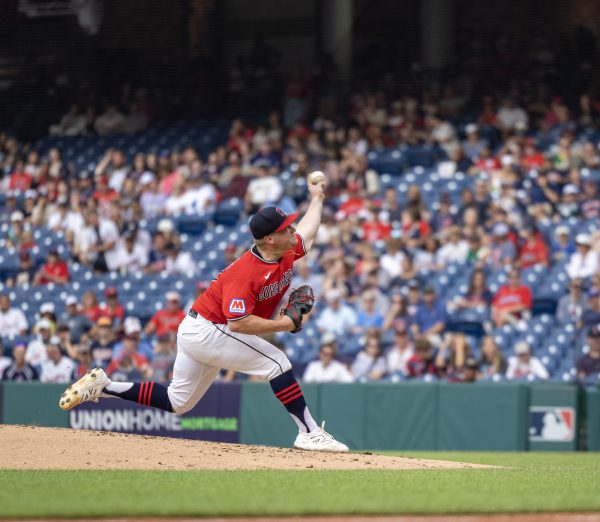
Photo by Charles Murray
Parker Messick has pitched like an October starter with a 2.53 ERA, while Gavin Williams has paired a 3.78 ERA with 228 strikeouts. Those are the two arms Cleveland should be arranging the stretch run around whenever rest permits. Tanner Bibee and Joey Cantillo remain important, but there is no prize for rigidly protecting a five-man routine while the season hangs by a thread.
Vogt has generally managed this bullpen well, and Cleveland’s relief corps has rewarded that trust. The unit ranked 10th in a recent leaguewide bullpen assessment, while Cade Smith, Colin Holderman, Erik Sabrowski, Tim Herrin and Hunter Gaddis all carried ERAs below 3.15. Smith’s 2.25 ERA, 35 saves and 13.1 strikeouts per nine innings make him the biggest late-game weapon. However, the September priority is continuity rather than reinvention. Keep matching the best available reliever to the highest-leverage situation while managing workloads for October.
Win the games that count twice
Seventeen games remain, including series against Minnesota, the division-leading White Sox, Boston and Kansas City. These are not ordinary dates on a schedule. Games against Chicago can swing the division race in both directions. The games against Boston influence wild-card positioning while divisional games may also matter in mathematical tiebreakers.
The target should be at least 10 wins over the final 17. That would put Cleveland at 83 victories which is not a guarantee, but a credible finishing mark in this compressed race. More importantly, the Guardians must take the White Sox series at Progressive Field. A club that wants October cannot politely split opportunities with the team standing between it and a division title.
Play for the berth, but prepare for the format
Three wild cards qualify from each league, and the opening round is a best-of-three series played entirely at the higher seed’s park. Cleveland’s first job is to get in. Its second is to avoid stumbling into October with an exhausted bullpen and no clear Game 1 plan. The club should begin lining up Messick and Williams for a potential wild-card series while protecting Smith and the top setup arms from needless multi-inning wear.
Tap into the heart that made history
More than any tactical adjustment, Cleveland needs to rediscover the stubborn belief that has become the heart of this club. Last season, the Guardians erased a 15½-game deficit against Detroit. This was the largest deficit overcome by a division champion. It was powered by a 17–5 September surge. That comeback was not luck. It was proof that this group can absorb adversity, keep the game close and apply pressure until an opponent cracks. The 2026 Guardians do not need to imitate every detail of that run, but they must tap into the same grit. They have already shown they can play their best baseball when the standings say the task is nearly impossible. Now they must summon that identity again, one relentless inning at a time.
The Guardians’ identity, pitching, defense, speed and discomfort, can absolutely win a short series. But first it must win a short season. September rewards teams willing to admit what they are. Cleveland is not a slugging juggernaut. It is a pitching-first club whose margin disappears when the lineup wastes chances or overworked relievers are asked to cover too many innings.
The verdict: Ride Messick and Williams, deploy Smith at the game’s true pressure point, stack the lineup with the players currently reaching base, and treat every remaining divisional game like an elimination game. The door to October is open. The Guardians do not need to kick it down. They simply need to stop standing in the doorway.






Recent Comments