
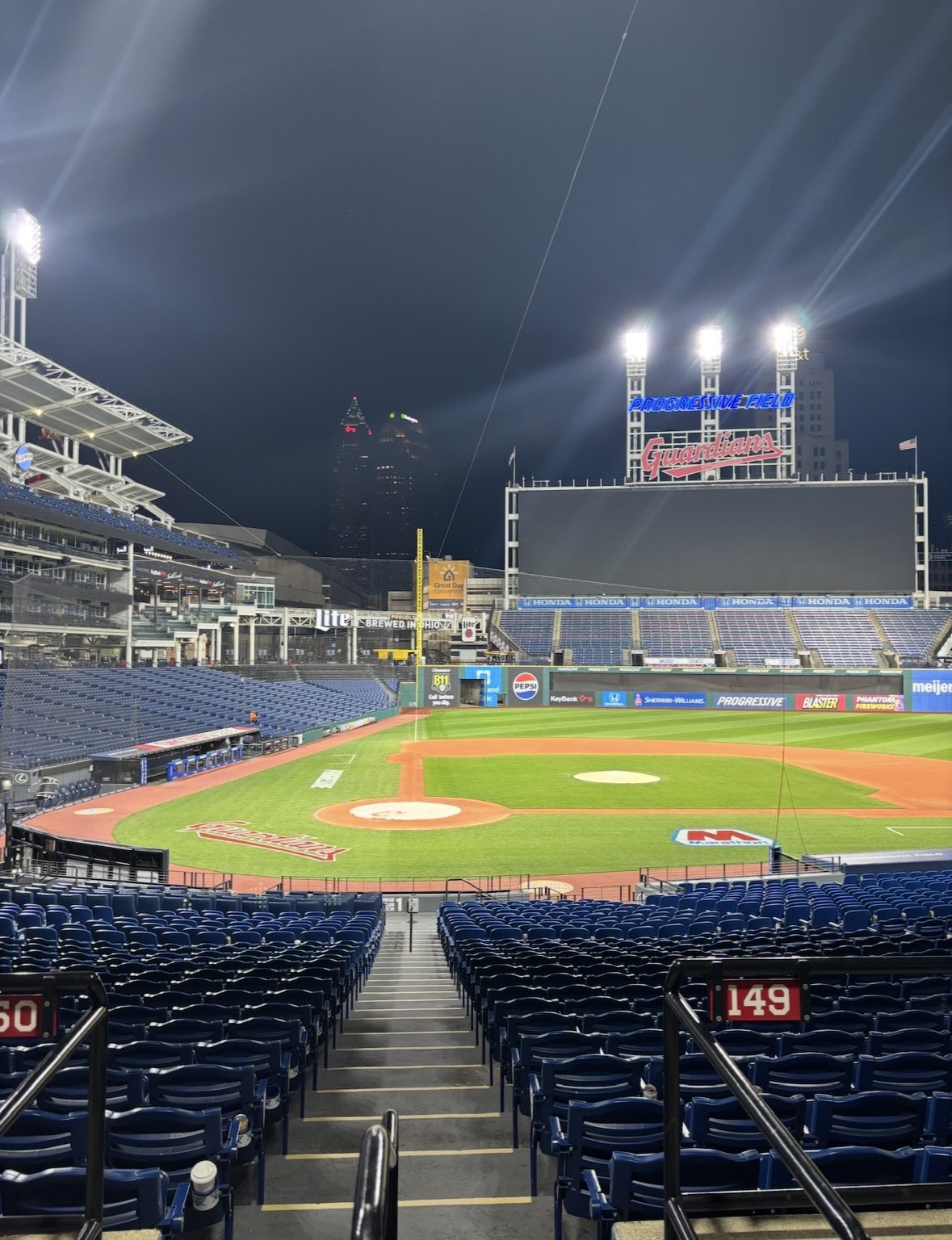
Baseball is romantic because it asks us to believe that time can run out and still leave something behind.
October, after the ending
There is a particular cruelty to the last baseball game of a season. The players remain in uniform. The lights are still on. The dirt still holds the day’s footprints. Yet in a matter of minutes, a summer that seemed capable of continuing forever becomes past tense.
That is where the Cleveland Guardians stood when their 2026 run finally ended. Not in the Division Series, as it once seemed destined to, but two wins short of the World Series…after Tampa Bay took the American League Championship Series in six games. The record book will file the season beneath a loss. Memory will be less obedient.
This is the romance of baseball. It makes room for heartbreak without allowing heartbreak to erase what came before it. A season can be unfinished and complete. A team can lose its final game and still give a city the rarest sporting gift…the feeling that every night might contain a miracle.
The chase
By late summer, Cleveland was not supposed to be here. The White Sox had built a 5½-game lead with six weeks left, the sort of margin that becomes a sentence when the calendar turns toward September. But the Guardians kept reducing the distance. One close game, one clean inning, one difficult at-bat at a time…until they had caught Chicago and claimed the American League Central again.
Nothing about the chase felt gaudy. Cleveland’s baseball was accumulative rather than theatrical. It lived in the extra base taken without applause, the cutoff man hit, the reliever who entered with traffic and left with silence. “We’ve posted all year, no one counts us in” manager Stephen Vogt told the team after the Division Series comeback. They returned each day and made the season answer another question.
That is another reason baseball feels romantic… its heroes do not always arrive with trumpets. Sometimes they arrive daily. They take batting practice in heat, play through hands that ache, and turn a deficit that looked permanent into a pennant race. The beauty is not merely in the comeback. It is in the repetition required to make a comeback possible.
Steven Kwan and the discipline of returning
Steven Kwan’s season contained its own comeback, quieter than the one in the standings but no less revealing. Through June, one of baseball’s surest leadoff hitters was batting .212, slugging .257 and confronting difficult questions: Was he getting older? Was his eye slipping? Had the league begun to solve him? Cleveland moved him out of the leadoff spot, an interruption of the familiar order that made the struggle impossible to ignore.
Kwan did not escape by becoming someone else. He returned to routine: the daily work, the stubborn attention to the strike zone, the insistence that a bad month did not require a new identity. From July 1 into mid-September, he led the American League in wins above replacement while batting .355 with a .441 on-base percentage. By season’s end, the ugly first half had been folded into a line that looked recognizably his again.
There is romance in power, but there is another kind in Kwan’s game, the romance of precision. He makes an art of the foul ball, the opposite-field single, the fly ball pursued until the wall interrupts him. In a sport increasingly designed around velocity and damage, he keeps making room for touch. His recovery helped Cleveland erase its division deficit because a chase begins with someone reaching first base.
Kwan later said the turnaround made him proud because he had kept his routines and tried to be a good person every day. That is not the language of conquest. It is the language of continuance, and it belongs in this season. The Guardians kept going. Kwan kept going. Eventually, the results caught up with the faith.
José playing through the ache
Every great Cleveland summer eventually finds José Ramírez at its center. In 2026, though, the familiar certainty had been interrupted. Surgery on his left hamate bone in June shadowed his season. Even when he returned, the effects lingered, and October began with the most dependable Guardian going hitless in the first two games of the Division Series.
Then the series bent toward him. With Cleveland facing elimination again and again, Ramírez went 5-for-12 across Games 3 through 5, drove in seven runs and hit two home runs. In the deciding game, he reached down for a pitch only 0.74 feet above the ground and sent it out for the two runs Cleveland would need. It was the lowest pitch hit for a postseason homer in the tracking era.
The swing looked like an act of refusal. Refusal to let injury define the year. Refusal to accept the first two losses as a verdict. Refusal, perhaps, to let Cleveland’s summer end while he still had one more impossible thing in him. When fans demanded that the city build the statue, the line landed because it sounded less like exaggeration than gratitude.
Ramírez’s story is baseball’s romance in miniature. The sport asks even its greatest players to fail publicly, then offers them another pitch. October did not restore an untouched version of him it revealed something more moving…a star diminished by pain who still found enough strength to tilt the month.
Twenty-one strikeouts and a city holding its breath
If Ramírez supplied the decisive swing in Game 5, Gavin Williams supplied the weather. He threw as though the evening belonged to him. 5⅔ scoreless innings, 12 strikeouts, a fastball averaging more than 99 miles per hour, and no hits allowed until the sixth. Two days earlier, he had made an emergency relief appearance to help close Game 4. Now he was emptying the tank in the game that would decide whether Cleveland kept playing.
Williams left to a standing ovation, which is one of baseball’s purest ceremonies. The pitcher walks slowly from the mound. The manager waits. The crowd rises not because the work is finished but because it understands what has been given. In that brief walk, performance becomes communal memory.
Erik Sabrowski, Hunter Gaddis and Cade Smith carried the shutout home. Together, Cleveland’s pitchers struck out 21 batters…the most ever in any nine-inning major-league game, regular season or postseason. Smith’s contribution came after he had already thrown 50 pitches across Games 3 and 4. This was not preservation. It was expenditure.
The Guardians won 2-0 and completed the comeback from an 0-2 series deficit, becoming only the 11th team to escape such a hole in a best-of-five postseason series. The arithmetic was simple. The experience was not. Three straight elimination games had turned every pitch into a ledge, and Cleveland had kept its balance.
Cade Smith keeper of the final outs
Every romantic baseball season needs someone entrusted with its endings. For Cleveland, that was Cade Smith, the tall right-hander from Vancouver who turned the ninth inning into a test of nerve. He finished the regular season with 41 saves, a 1.95 ERA and 107 strikeouts…numbers that describe dominance but not the peculiar loneliness of standing on the mound while an entire season waits behind you.
On September 24 in Boston, Smith threw an 88.7-mile-per-hour splitter past Ceddanne Rafaela for the final out that secured Cleveland’s third consecutive postseason berth. The pitch lasted an instant. Everything required to reach it…the spring innings, the summer strain, the late chase of Chicago…seemed to release when the ball reached the catcher’s glove.
October demanded even more. Smith worked four of the five Division Series games. He struck out five in two perfect innings in Game 3, returned for Game 4, and in the clincher recorded four strikeouts across 1⅔ hitless innings for the save. Fifty pitches across Games 3 and 4 did not keep him from taking the ball again. A closer’s job is often described as protecting a lead. Smith’s work felt more elemental… he protected tomorrow.
He saved Game 3 of the Championship Series, too, preserving the 3-2 lead created by Petey Halpin’s homer. The last game was harsher, as last games often are. Tampa Bay finally reached him, and the season ended without the clean ninth inning Cleveland had imagined. But one difficult night could not undo the months in which Smith stood at the edge of victory and made the final three outs belong to the Guardians.
Relievers live close to impermanence. They may throw only a handful of pitches, and each one can revise the evening. Smith’s season was romantic not because he was invulnerable, but because he kept accepting that risk. Again and again, the bullpen gate opened, and he ran toward the possibility that everything might depend on him.
The unlikely swing
Baseball’s romance also depends upon the person we were not watching closely enough. In Game 3 of the Championship Series, with the game in Cleveland and the Rays ahead 2-1, Petey Halpin met a 96-mile-per-hour sinker and drove it into the right-field seats for a two-run homer.
Before the ball landed, Halpin backed away from the batter’s box and watched. Then his bat flew into the air, spinning above him like a windmill. Progressive Field shook. The Guardians had a 3-2 lead and, for a moment, the shortest distance between Cleveland and the World Series seemed to run directly through an outfielder becoming a postseason hero in real time.
Afterward, Halpin said that if it had not been him, it would have been somebody else. That sentence might be the truest description of this team. Cleveland’s faith was not that one superstar would rescue everyone. It was that the game would eventually ask somebody a question, and somebody known or unknown, healthy or hurting, fresh or overworked would answer.
What the loss could not take
Tampa Bay won the Championship Series in six games. That is the clean sentence, the one that belongs in brackets and databases. It says nothing about how close Cleveland came, how loudly the ballpark trembled, or how a fan learns to organize October around first pitch. It cannot hold the private rituals .. the lucky shirt, the same seat, the text sent before every game, the radio carried from room to room.
Loss does not make those things foolish. It makes them precious. Baseball gives us abundance, 162 regular-season games, and then teaches us scarcity. Suddenly there may be three games left, then one, then nine innings, then one strike. The entire summer narrows until it can fit inside a single pitch. When that pitch passes, what remains is everything we noticed along the way.
For the Guardians, that means the late-season chase that erased 5½ games. It means Ramírez reaching toward the dirt and lifting a city. It means Williams throwing smoke in the rain, Sabrowski escaping with the bases loaded, Smith answering the bullpen door once more, and Halpin admiring the flight of a ball that briefly made the World Series feel close enough to touch.
It also means the failures, because romance without vulnerability is merely marketing. Ramírez made a costly error in the Championship Series. The bats went quiet at the wrong time. Tampa Bay found the four wins Cleveland could not. Baseball is beautiful partly because it refuses to protect the people we love from the game’s hardest truths.
The reason we come back
Perhaps that is why baseball is the most romantic game…it is always disappearing. Every pitch vanishes as soon as it reaches the glove. Every season spends itself toward autumn. Every player is young until, almost without warning, he is not. The sport trains us to cherish what cannot be kept.
Cleveland’s 2026 season will not have a championship banner attached to it. It has something more intimate. It has stories that will grow in the telling: the 21 strikeouts, the three straight elimination wins, the wounded superstar’s impossible homer, the unlikely bat tossed into the October air.
Years from now, the details will blur at their edges. The standings will require looking up. But someone will remember where they were when Ramírez went down and got that pitch, how the crowd sounded when Williams walked off, how for several weeks the Guardians made the city believe that no deficit was final.
And when spring returns, assuming the owners and players reach an agreement before the labor dispute delays spring training, that belief will return with it. The grass will be impossibly green. The scorecard will be blank. A pitcher will lean in for the sign, a hitter will settle his feet, and time…so unforgiving in October…will begin again.






Recent Comments